
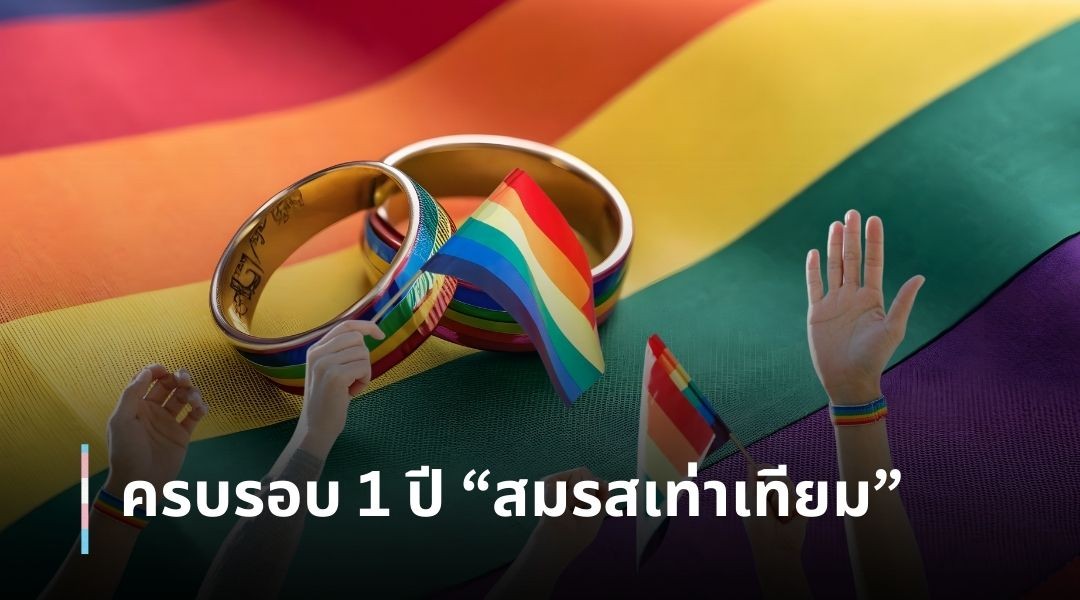
January 23, 2026 marks another historic milestone in Thailand’s human rights journey, as the Marriage Equality Act reaches its first full year of implementation. This legislation does more than alter the legal status of same-sex couples; it stands as a powerful symbol of state-level recognition of the dignity, equality, and humanity of people of diverse sexual orientations and gender identities.
The success of marriage equality did not emerge from benevolence on the part of the state. Rather, it is the result of more than two decades of sustained struggle by grassroots movements, LGBTQIAN+ communities, legal advocates, human rights defenders, and civil society organizations who refused to give up. Through street demonstrations, policy proposals, legislative advocacy, and persistent efforts to shift public attitudes, voices that were once silenced have become a transformative force, permanently reshaping Thailand’s family law framework.
One Year of Numbers, One Year of Real Lives
According to data from the Department of Provincial Administration, between January 23, 2025 and January 12, 2026, a total of 265,816 couples registered their marriages. These registrations are categorized as follows:
- Female–female couples: 20,083
- Male–male couples: 6,203
- Male–female couples: 239,530
These figures clearly demonstrate that marriage equality is not a law designed for “a specific group,” but a reform that expands the right to marry to all people on equal terms. At its core, the law affirms universal principles of love, commitment, and the freedom to form a family by mutual consent.
Yet beneath these concrete statistics lies a structural limitation embedded within Thailand’s bureaucratic systems. Marriage registration data continues to be classified strictly according to sex assigned at birth, recognizing only “female” and “male.” As a result, the state relies on categories such as “female–female” and “male–male” marriages, which fail to fully capture the diverse realities of people’s gender identities.
In practice, many individuals are transgender, non-binary, or possess gender identities that do not align with their sex assigned at birth. The existence of only two gender markers in official systems effectively erases these identities at the data level. Consequently, the publicly reported figures on marriage equality may underestimate the true number of marriages and cannot fully reflect the breadth of gender diversity present in Thai society.
Marriage Equality Cannot Stand Alone
For this reason, the advancement of the Gender Identity Recognition Act on gender identity, gender expression, and sex characteristics is not merely an additional legal reform. It is an essential mechanism that must move forward alongside marriage equality to ensure that legally recognized rights align with people’s lived realities.
Legal recognition of gender identity would allow individuals to use titles, gender markers, and personal information in official documents that accurately reflect who they are. This recognition would reduce discrimination and humiliation, while enabling equitable access to rights, welfare, and public services — including healthcare, social security, family-related rights, and access to justice.
Barriers After Legal Victory

Although marriage equality has now been in effect for a full year, many diverse-gender couples continue to face obstacles in exercising their rights in practice. A key reason is that both public and private institutions are still in the process of revising more than 50 subordinate laws, regulations, and administrative guidelines to align with the new legislation.
Delays in these systemic adjustments have meant that some married couples are still unable to fully utilize their legal status to access benefits, such as civil servant welfare, family-related leave, medical coverage, or certain tax benefits. These challenges highlight a critical reality: amending a single primary law is insufficient without comprehensive structural reform to support its implementation.
One Year That Proves Equality Is a Process, Not a Destination
The developments observed during the first year of marriage equality clearly affirm that legal recognition is only the beginning of a longer journey. Achieving genuine equality requires sustained collaboration across all sectors — legislators, government agencies, private institutions, and society as a whole.
Advancing related legal reforms, recognizing diverse identities, and respecting the inherent dignity of every individual lie at the heart of democracy and human rights. Marriage equality is not the conclusion of the struggle, but the opening of a new chapter — one that calls on Thailand to continue moving toward a society where no one is left behind.
Sources and further reading
Primary and authoritative sources used for context and fact-checking.
- Frequently asked questions on sexual and gender diversity, health and human rights World Health Organization (WHO)
- The Thai Handbook of Transgender Healthcare Services IHRI & Center of Excellence in Transgender Health, Chulalongkorn University
- Standards of Care for the Health of Transgender and Gender Diverse People, Version 8 World Professional Association for Transgender Health (WPATH)
- Consolidated guidelines on HIV, viral hepatitis and STI for key populations (2022) World Health Organization (WHO)
- STI Treatment Guidelines: Transgender and Gender Diverse Persons U.S. Centers for Disease Control and Prevention (CDC)
- Legal Gender Recognition in Thailand: A Legal and Policy Review United Nations Development Programme (UNDP)
- The struggle of trans and gender-diverse persons United Nations Human Rights (OHCHR)